
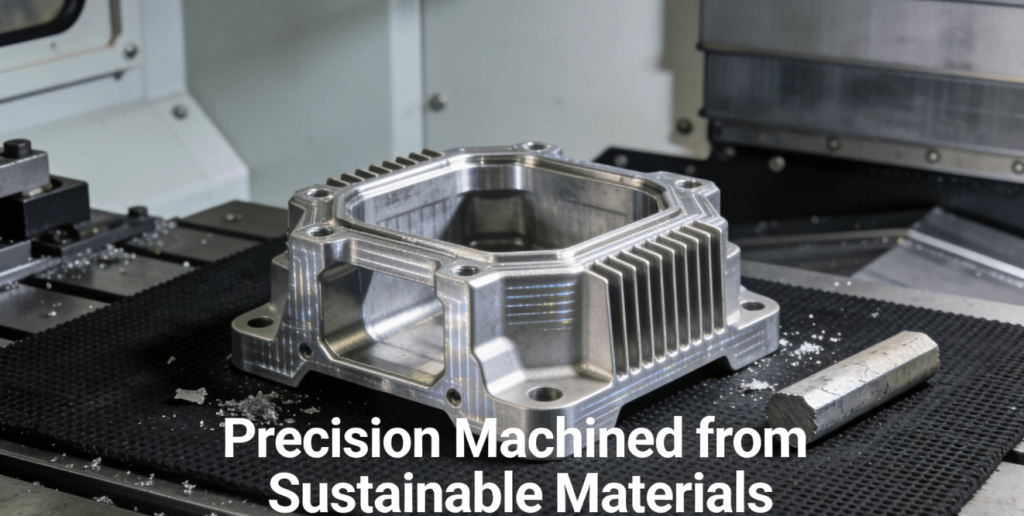
Introduction
Modern manufacturing faces a dual imperative: meeting the ever-increasing demands for precision and performance in sectors like consumer electronics and automotive, while simultaneously reducing carbon footprint and material waste under tightening environmental regulations and ESG investment trends. The core challenge lies in the perceived trade-off. When utilizing sustainable materials like recycled metals or bio-based plastics, their inconsistent physical properties—such as variable hardness or embedded impurities—can pose significant hurdles for CNC machining services, leading to accelerated tool wear and lower part yield. This often makes “sustainable” and “high-precision” seem mutually exclusive.
This article demonstrates that through innovative process strategies, intelligent CNC machining center control, and an integrated green quality management system, it is entirely possible to achieve high-quality machining of sustainable materials without compromising performance. The following five key questions will deconstruct this new paradigm for precision manufacturing.
Which Sustainable Materials Are Reshaping Manufacturing Through CNC Machining?
The concept of material circularity, exemplified by initiatives like sustainable wool recycling in the textile industry, is gaining powerful traction in manufacturing. A new generation of engineered sustainable materials is now viable for precision components. This includes post-consumer recycled aluminum alloys, regrind and bio-based engineering plastics (e.g., PA 6/10 from castor oil), and advanced polymers derived from renewable sources. The environmental benefits are substantial; for instance, using recycled aluminum can reduce the carbon footprint associated with material production by up to 95% compared to primary aluminum.
These materials are becoming the preferred choice for custom machined parts not solely for their green credentials, but also for their ability to meet specific mechanical, thermal, or chemical resistance requirements. Recycled aerospace-grade aluminum, for example, can match the strength-to-weight ratio of its virgin counterpart, making it ideal for lightweight automotive or drone frames. The first critical step is identifying a CNC machining services provider with proven expertise in characterizing and processing these variable feedstock materials, turning their ecological potential into reliable, high-performance components.
How Does Precision CNC Machining Transform Eco-Materials into Reliable Parts?
Successfully machining sustainable materials requires a nuanced, technology-driven approach. Specialized precision CNC machining services must adapt their strategies in three key areas to ensure consistency and reliability.
Pre-Production Planning and Simulation
The successful machining of variable sustainable materials begins long before the tool meets the stock. A proactive, two-pronged strategy in planning is essential. First, tooling and parameters must be optimized. This involves selecting cutting tools with specialized, wear-resistant coatings (like AlTIN) to handle abrasive impurities, and meticulously testing speeds, feeds, and depth of cut to find the efficient “sweet spot” that minimizes tool stress. Second, intelligent CAM programming and simulation are critical. Using sophisticated software, programmers simulate the entire process to predict and mitigate issues like thermal expansion or residual stress caused by material inconsistency, allowing for pre-emptive toolpath adjustments to ensure the final part’s dimensional stability.
The Role of the Modern Machining Center
Modern multi-axis CNC machining centers are indispensable for processing sustainable materials. Their high dynamic performance and closed-loop control systems enable real-time adjustments during cutting, actively compensating for material inconsistencies to ensure uniform quality and tight tolerances across every part in a production batch.
- Dynamic Performance and Closed-Loop Control
The advanced capabilities of a multi-axis CNC machining center are pivotal for execution. Its high dynamic performance enables smooth, continuous machining of complex geometries, avoiding sudden load changes that could exploit material weaknesses. Crucially, modern centers with closed-loop feedback systems can make real-time micro-adjustments. By monitoring cutting forces or vibrations, the machine actively compensates for slight hardness variations within a material batch, ensuring consistent finish and tolerance across all parts.
Ensuring Process Consistency
This real-time adaptation is what separates capable from exceptional shops. It transforms a passive operation into an active, responsive process, guaranteeing that every part, from the beginning to the end of a recycled material batch, meets the identical specification. For a deeper dive into how this precise control is achieved, a detailed guide on precision CNC machining fundamentals is an excellent resource.
How Do IATF 16949 and ISO 14001 Jointly Guarantee “Green” and “Precision”?
The fusion of rigorous quality and environmental management systems provides the foundational assurance for sustainable precision manufacturing. Standards like IATF 16949 (automotive) and AS9100D (aerospace) mandate a zero-defect culture, enforced through rigorous process control, full traceability, and continuous improvement. For a CNC machining parts supplier, this means every step for a safety-critical component is documented, verified, and reproducible, ensuring absolute reliability.
Concurrently, the ISO 14001 framework provides a systematic approach to environmental management. As outlined by the International Organization for Standardization, it requires organizations to establish a system for managing their environmental responsibilities in a holistic manner. This translates to structured efforts in reducing energy and water consumption, managing chemical waste, and formally prioritizing the use of sustainable materials within the supply chain. Leading manufacturers don’t treat these as separate systems; they integrate them. A supplier holding both IATF 16949 and ISO 14001 certifications demonstrates that environmental stewardship is built into a quality-assured process. This proves that “green manufacturing” isn’t a compromise on reliability but an enhancement achieved through systematic, audited control. For instance, manufacturers like CNC protolabs, which hold these certifications, exemplify this dual-capability approach.
How to Overcome High-Precision and Thin-Wall Challenges When Machining Complex Sustainable Materials?
Machining intricate features like deep internal cavities or ultra-thin walls (<0.5mm) from sustainable materials presents a supreme test of capability. The inconsistent microstructure of some recycled stocks can exacerbate challenges with vibration, heat dissipation, and part deflection.
Advanced Machining Strategies for Delicate Features
- Countering Vibration and Heat
Vibration and heat are major challenges when machining thin walls in variable materials. Dynamic toolpath optimization and tuned toolholders suppress chatter. Trochoidal milling and constant engagement paths distribute heat and force evenly, preventing warpage.
- Precision Tooling and Sustainable Lubrication
Five-axis machining maintains optimal tool orientation for better finishes and less stress. Minimum Quantity Lubrication (MQL) applies a precise, biodegradable lubricant, drastically reducing waste while ensuring effective cooling and chip removal.
Ensuring Accuracy with In-Process Verification
For tight tolerance CNC machining services, final inspection cannot wait. On-machine probing and in-process gauging allow real-time measurement. If a drift is detected, the system automatically compensates in subsequent operations, ensuring first-pass success and near-zero scrap, which is essential for complex parts.
How to Choose a Sustainable Precision Machining Partner, Balancing Cost, Lead Time and Ecological Responsibility?
Selecting the right sustainable precision manufacturing partner demands a holistic evaluation beyond unit price, focusing on Total Cost of Ownership (TCO). A slightly higher piece-part cost can be offset by superior yield, less waste, and reduced quality issues. A leading partner offers transparency regarding environmental performance and material lifecycles, coupled with a flexible best online CNC service that scales from prototype to production.
This includes integrated DFM feedback that optimizes for both economy and ecology. Ultimately, the strategic choice balances local production’s lower emissions against a global network’s resilience. The ideal CNC machining parts supplier seamlessly blends technical precision with a verifiable, operational commitment to sustainability.
Conclusion
The application of sustainable materials in high-precision part manufacturing is no longer a conceptual ideal but an industrial reality. It is driven by advanced CNC technologies, integrated quality and environmental management systems, and forward-thinking supplier partnerships. This convergence is not merely about ecological responsibility; it is a strategic investment that enhances supply chain resilience, future-proofs against regulations, and delivers uncompromised performance.
Is your next project in search of a manufacturing solution that achieves extreme tolerances like ±0.005mm while significantly reducing environmental impact? Upload your part drawings to receive a detailed quote that integrates sustainability analysis with precision manufacturing costs.
Author Bio
This article was written by an expert with over 15 years of experience in the precision manufacturing sector, specializing in integrating advanced machining technology with sustainable manufacturing practices. His insights are drawn from continuous observation of global supply chains and cutting-edge production techniques.
H2:FAQs
Q1: Will the performance of parts be compromised if recycled materials are used for CNC machining?
A: Not necessarily. Through stringent incoming material inspection, tailored tooling and process optimization, and precision quality control, parts machined from qualified recycled materials (such as 6061-T6 recycled aluminum) can meet the same mechanical performance standards as those made from virgin materials.
Q2: Is sustainable precision machining significantly more expensive than the traditional approach?
A: Initial material or process development costs may be slightly higher. However, through higher material utilization rates, lower scrap rates, and energy-efficient processes, the Total Cost of Ownership (TCO) is often comparable or even lower. The cost advantage becomes more pronounced at production scale.
Q3: How can I verify if a CNC supplier genuinely meets environmental standards?
A: Beyond requesting certificates like ISO 14001, ask for specific data points such as energy consumption per part, water recycling rates, and the verified disposal or recycling streams for different waste types. A reputable supplier will be transparent and willing to share this information.
Q4: Can sustainable manufacturing solutions be applied to low-volume prototype work?
A: Absolutely. Progressive online CNC service providers offer sustainable material options for low volumes and can incorporate eco-conscious process recommendations into their DFM analysis, making it possible to integrate sustainability from the very first prototype.
Q5: Can sustainable materials be used for parts requiring strict industry certifications (e.g., medical, automotive)?
A: Yes, but the process is more rigorous. The key is that the supplier must hold the relevant industry-quality certifications (like IATF 16949 or ISO 13485) and be able to provide complete traceability documentation from raw material to finished part, proving compliance with all applicable standards.