
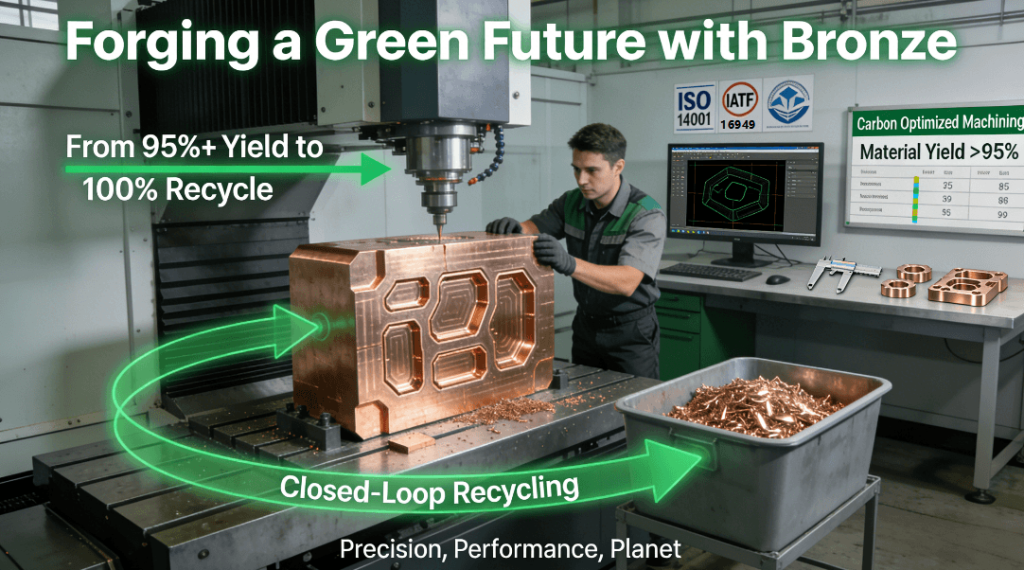
In the quest for sustainable manufacturing, bronze is frequently selected for critical applications due to its excellent corrosion resistance, thermal conductivity, and mechanical properties. However, its machining process is often viewed as inherently resource-intensive. Excessive tool wear from the material’s stickiness, part scrappage from thermal deformation, and the generation of significant scrap volumes from inefficient methods undermine the “green” potential of this valuable alloy from the very first manufacturing step.
The core issue is that traditional approaches to bronze machining have not systematically engineered for “resource intensity” and “process stability” as core parameters. Outdated techniques, non-optimal cutting parameters, and a lack of closed-loop management for material flow — especially scrap — prevent valuable bronze from realizing its full lifecycle value. This article reveals how a data-driven, system-optimized precision bronze CNC machining paradigm can reverse this, demonstrating how to achieve material yields exceeding 95% and significantly reducing environmental impact.
Is Bronze Inherently “Wasteful” to Machine? Redefining Efficiency from the First Cut.
Sustainable bronze machining begins with a foundational commitment to maximizing material efficiency. For a standard bronze billet, conventional methods with poor nesting might yield only 60-70% of useful part material. In contrast, advanced precision bronze machining leverages intelligent CAM software for optimal nesting and utilizes near-net-shape stock, dramatically reducing the “buy-to-fly” ratio to 5% or less. This single-step optimization conserves over 25% of raw material at the source, directly cutting the embodied carbon associated with mining, smelting, and transportation.
1. The Science of Systematic Resource Optimization
This data-driven approach to resource efficiency aligns with authoritative frameworks for smart and sustainable production. Entities like the National Institute of Standards and Technology (NIST) emphasize the role of integrated digital tools and process modeling in minimizing waste. In bronze machining, this translates to simulating material removal paths to ensure every cut is purposeful, turning raw stock into product with minimal residual scrap, a core principle of modern Material Engineering Innovations.
2. Overcoming the Bronze-Specific Machining Hurdle
Achieving this extreme efficiency requires overcoming bronze’s inherent machining challenges. Its high stickiness and thermal conductivity demand specialized strategies to prevent tool loading, poor surface finish, and part distortion. Success hinges on a deep understanding of bronze-specific tool geometry, coatings, and parameter windows that balance material removal rates with tool life and part quality, ensuring high yield doesn’t come at the cost of precision.
3. From Stock to Part: The Digital Blueprint for Yield
The journey to 95%+ yield starts in the digital realm before any metal is cut. Advanced CAM systems perform virtual nesting, arranging parts within the stock to maximize usage. They can also generate adaptive toolpaths that remove material only where absolutely necessary, preserving stock for additional features or future parts. This meticulous digital planning is the non-negotiable first step in transforming bronze from a commodity into a high-utilization engineering asset, a topic explored in detail regarding effective bronze CNC machining techniques.
Can a Cutting Tool’s Path Be “Carbon Optimized” for Sticky Bronze?
The sustainability of machining extends beyond material savings to the energy and quality of the cut itself. For gummy bronze, a high-speed machining strategy — employing high spindle speeds with moderate feed rates — is a key enabler. This approach produces thinner, more manageable chips that efficiently carry the majority of cutting heat away from the workpiece, enabling a “cooler cut” that minimizes thermal distortion risks and reduces the energy consumed per unit volume of material removed.
- The Mechanics of Efficient Chip Formation: Optimizing chip formation is critical for both quality and energy use. Dull tools or improper parameters cause thick, poorly formed chips that require more energy to shear and retain heat, damaging the part and tool. For bronze, using sharp tools with positive rake angles and polished flutes ensures a clean, efficient shear, lowering cutting forces and power consumption. This refined approach is a hallmark of Sustainable Manufacturing Technologies in practice.
- Strategic Cooling and Lubrication: The management of cutting fluids is a dual sustainability concern. While necessary to manage heat and lubricate the cut for bronze, fluid use, disposal, and potential misting have environmental impacts. Advanced strategies like Minimum Quantity Lubrication or using specifically formulated, longer-life biodegradable coolants can drastically reduce fluid consumption and waste. Proper filtration and recycling systems further close the loop, minimizing the process’s overall ecological footprint.
- The Data Feedback Loop for Continuous Improvement: Truly optimized bronze cutting parameters are not static; they are refined through a closed-loop system. Monitoring spindle power draw, tool wear rates, and part quality over time allows for the fine-tuning of speeds and feeds. This data-driven refinement continuously seeks the most energy-efficient point that still delivers impeccable part quality, embodying the principle of continuous improvement in Advanced Manufacturing Processes.
From Bronze Swarf to Premium Ingot: Closing the Loop in Metal Recycling
The ultimate expression of circularity in bronze machining is the seamless return of scrap to the production cycle. Professional bronze CNC machining services implement strict protocols for segregating and collecting clean bronze chips. Unlike mixed waste streams, this high-purity feedstock can be returned directly to foundries for remelting. The energy required to recycle bronze is a mere 10-15% of that needed for primary production from ore, completing a true material closed-loop.
1. The Economic and Environmental Value of Clean Scrap
Segregated, oil-free bronze chips are a valuable commodity, not waste. Contamination from other metals, plastics, or excessive cutting oil significantly degrades the value and usability of recycled bronze. A disciplined shop treats chip management as a critical quality and sustainability operation, ensuring the output waste stream is a high-grade input for the recycling industry, directly supporting Circular Economy Applications.
2. Integrating Recycling into the Manufacturing Workflow
True closed-loop management requires systemic integration. This means having dedicated containers for different bronze alloys (e.g., C932 tin bronze separate from C954 aluminum bronze), procedures for removing excess coolant, and partnerships with certified recycling facilities. This operational discipline ensures that the environmental and economic benefits of recycling are fully captured and verifiable, turning a cost center (waste disposal) into a value stream.
3. The Full Lifecycle Perspective
Therefore, evaluating a manufacturing partner’s sustainability requires looking at the entire journey of the material. An efficient process that yields 95% parts is excellent, but a world-class system also ensures the remaining 5% is captured and upcycled. This holistic view — from efficient conversion to responsible reclamation — is what defines leadership in Industrial Recycling Solutions. Realizing bronze’s full potential, therefore, depends on partnering with capable CNC machining services that control the entire process from technique to reclamation.
Does Precision Machining Itself Extend Product Life and Reduce Waste?
Precision in manufacturing is a direct contributor to product sustainability by enhancing durability. A bronze component machined to exceptional dimensional accuracy, superior surface finish, and with controlled residual stresses will perform more reliably and last longer in demanding applications like heavy-duty bearings, marine valves, or high-load gears. This extended service life delays replacement, reducing the frequency of manufacturing cycles and the associated resource consumption over time.
- Surface Integrity as a Durability Driver: The final machined surface dictates in-service performance. For bronze, a well-finished surface with minimal micro-cracks or tensile stresses significantly improves resistance to wear, corrosion, and fatigue crack initiation. Precision bronze machining achieves this not just in a final pass, but through a controlled process from roughing to finishing that protects the material’s integrity, yielding a part that is inherently more robust and longer-lasting.
- Mitigating In-Service Failure Through Process Control: Many premature failures stem from hidden stresses or subsurface damage introduced during machining. Advanced techniques focused on Bronze machining deformation control — such as balanced clamping, sequential machining to relieve stress, and thermal management — produce parts that are stable and predictable in operation. This reduces unexpected downtime, maintenance events, and the waste generated from early part replacement.
- Building Longevity into the Quality System: A manufacturer’s commitment to longevity is embedded in its management systems. Standards like ISO 14001 (Environmental Management) and IATF 16949 (Automotive Quality) foster a lifecycle mindset. They require systematic process controls, preventive action, and continuous improvement — all of which drive the production of more reliable, durable components. This systemic approach ensures sustainability is engineered into the product, not an afterthought.
The Sustainable Supplier Audit: 3 Metrics Beyond the Bronze Quote
Selecting a bronze machining partner for a green future requires auditing tangible sustainability metrics, not just marketing claims. Move beyond unit price and investigate their operational ethos. First, request documentation: an average material utilization report for past bronze projects and certificates detailing scrap recycling destinations and volumes. This provides hard evidence of their resource efficiency.
1. Probing Energy Intelligence and Waste Stream Management
Second, inquire about energy monitoring and conservation. Do they track energy consumption per machine or output? What measures (e.g., high-efficiency motors, off-peak scheduling) are in place? Third, scrutinize their management of process consumables. How is cutting fluid handled, filtered, and eventually disposed of or recycled? A progressive supplier will have plans to reduce, reuse, and responsibly manage all input streams.
2. Evaluating Systemic Commitment and Transparency
The most revealing questions test systemic integration. Can they explain how sustainability goals influence process planning and operator training? Will they provide a walkthrough of their chip collection and segregation stations? Their willingness and ability to provide transparent, data-backed answers to these questions separates those with a deeply embedded green manufacturing culture from those with superficial claims.
3. The Partner as an Extension of Your ESG Goals
Ultimately, your manufacturing partner is an extension of your Environmental, Social, and Governance footprint. Their practices directly contribute to the lifecycle impact of your bronze CNC machined parts. Choosing a partner who can demonstrate validated performance in material yield, energy efficiency, and closed-loop recycling transforms your supply chain from a compliance item into a source of competitive advantage in Eco-Friendly Material Processing and resilient, future-proof custom bronze CNC machining.
Conclusion
As manufacturing accelerates its transition toward a circular economy, precision bronze CNC machining emerges as far more than a shaping technology. It is a powerful engineering lever connecting material science, radical resource efficiency, and product longevity. By embracing a manufacturing paradigm that fuses maximal material utilization, low-carbon processing, and closed-loop recycling, companies can secure high-performance bronze components while dramatically reducing the product’s full lifecycle environmental footprint. This builds the green competitiveness and business resilience required for a sustainable future.
FAQs
Q: What is the realistic material utilization rate for optimized bronze CNC machining, and is 95%+ achievable?
A: Yes, 90-95% material yield is an achievable industry best practice for optimized bronze machining. It is accomplished through advanced CAM nesting, using near-net-shape stock, and multi-part machining strategies. Utilization significantly below 80% often indicates substantial room for process optimization and cost savings.
Q: How does the energy footprint of machining bronze compare to machining steel or aluminum?
A: Bronze’s energy per volume removed is often comparable to steel with optimized parameters. Its high thermal conductivity aids heat dissipation. The major sustainability advantage lies in bronze’s exceptional recyclability (using ~10-15% of virgin production energy) and the long service life of precision-machined components.
Q: Can all types of bronze chips (tin bronze, aluminum bronze) be recycled together?
A: No, different bronze alloy chips should be strictly segregated. Mixing alloys contaminates the recycled melt, reducing its value and properties. Professional shops collect chips by specific alloy (e.g., C93200, C95400) to ensure they can be returned as high-value, grade-specific feedstock to foundries.
Q: Does achieving tighter tolerances and better surface finishes on bronze inherently require more energy and create more waste?
A: Not necessarily. A well-planned process minimizes waste by achieving accuracy early. Advanced tooling and bronze-optimized parameters can produce excellent finishes efficiently. The primary waste is excess material; a precise process from the start minimizes that total volume, regardless of final finish quality.
Q: How can I as a designer contribute to more sustainable bronze CNC machining?
A: Designers have key influence: use standard stock sizes to minimize waste, specify appropriate (not overly tight) tolerances, consolidate multiple parts into one to reduce material and assembly, and engage your manufacturer early for Design for Manufacturability feedback focused on bronze-specific material and energy efficiency.
Author Bio
This article stems from LS Manufacturing’s ongoing exploration and practice within the field of precision manufacturing — specifically, their efforts to integrate engineering excellence, resource efficiency, and environmental responsibility. The insights presented herein reflect the real-world challenge of balancing technical performance with sustainable outcomes in practical operations. Are you interested in optimizing the performance of your next batch of bronze components while simultaneously improving their environmental impact? Contact them today to turn your vision into reality.